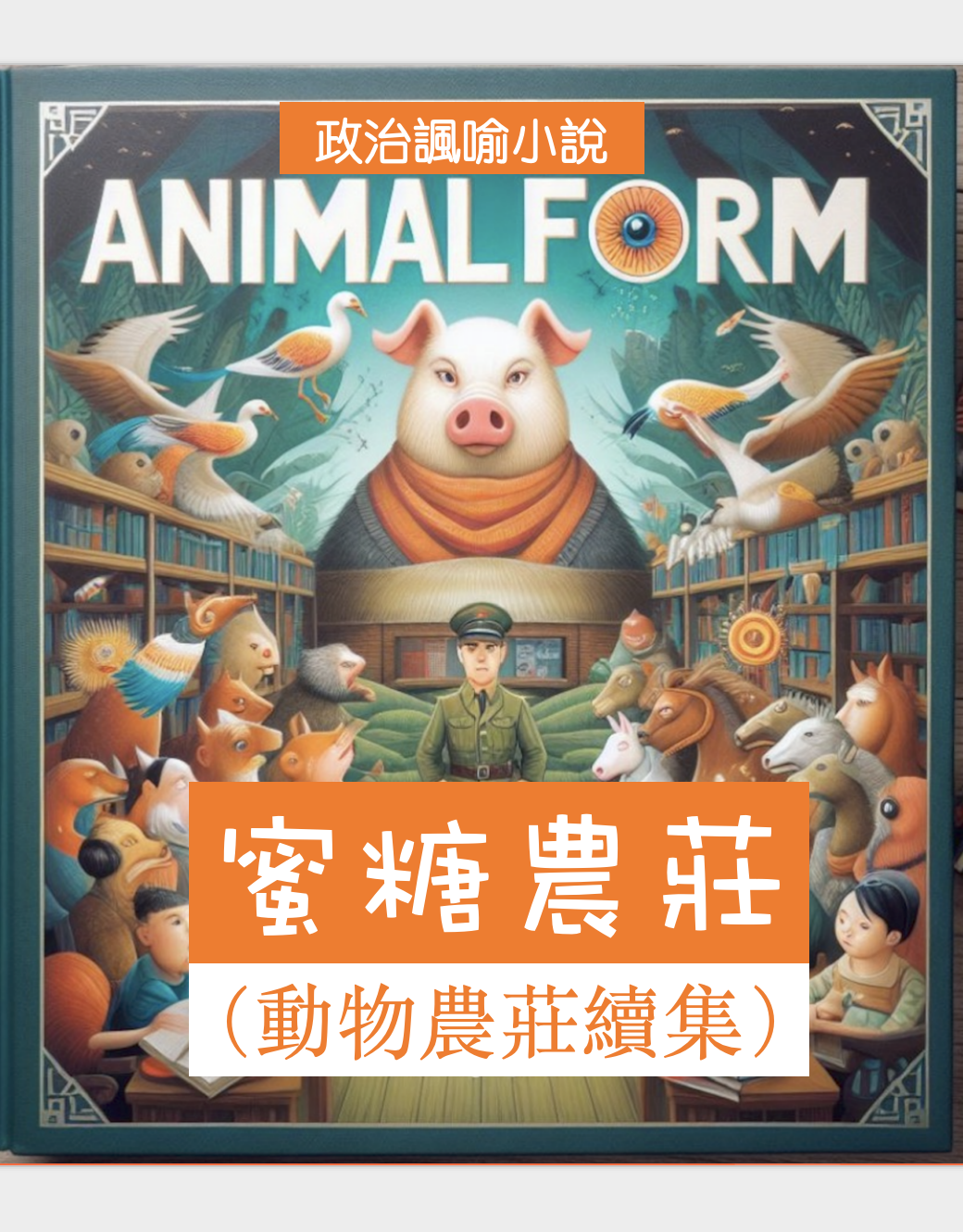
Chapter Six: The Heart of the Beast
Though Toad Pig held sway over Honey Farm, humans and animals alike languished on the edge of poverty. The pantry wasn’t yet bare, but meager, nutrient-poor rations sapped people’s drive to work. Oxen summoned to plow groaned about scarce feed, their ribs jutting, too weak to toil; hens laid eggs ever smaller, as if mocking the land’s barrenness.
The pigs and dogs relied on Northwest Farm for their feasts. But lately, Honey Farm’s puny eggs sparked complaints, escalating tensions until Northwest Farm cut off the coveted jam, beer, and whiskey. The farm’s goblets sat empty, and the pigs’ and dogs’ faces grew grim.
Toad Pig brooded, perplexed. Under Animalism’s banner, why did Northwest Farm’s agriculture thrive, producing jam and liquor, while Honey Farm floundered? After much thought, it dispatched Hu Ling to uncover the truth.
Meanwhile, Toad Pig sought aid from other farms. It and Hu Ling glimpsed a richer, freer world: the distant “Beautiful Farm,” overflowing with honey, fruits, and delicacies, where humans and animals coexisted harmoniously—a model farm. Trading with it promised boundless profit.
If all farms were a village, Beautiful Farm was its governing council. Yet its head knew nothing of the walled-off Honey Farm. When this baffling land extended an olive branch, the head investigated, finding poverty and ignorance. Beautiful Farm offered tariff-free aid, hoping to lift Honey Farm from Animalism’s mire of folly.
Hu Ling’s probe into Northwest Farm revealed the key: its pigs deftly employed human expertise for critical tasks. Toad Pig, however, had branded intellectuals and specialists as reactionaries and enemies, hollowing out Honey Farm’s minds with ignorance.
To reverse the decline, Toad Pig resolved to promote select humans, favoring those who knelt most abjectly. Honey Town’s Hu Ling, erudite and brimming with cunning, had knelt first, barking like a dog, earning Toad Pig’s trust. He was promptly named chief strategist of the Pig Throne Building. Uncle Gui, though less flamboyant in his groveling, was earnest enough to be tasked with reviving agriculture. Grandma Sun became the human delegate, nodding and raising her hand on cue. Zhao Pig Farmer was sent to study brewing. These appointments, while seeming to bridge the human-animal divide, added another absurd stroke to the power charade.
Uncle Gui, a guileless farmer, knew nothing of agriculture but recalled ancestral wisdom: coexist with birds and beasts, letting them multiply naturally to curb pests. Rejecting the pigs’ and dogs’ radical decrees, he spared the sparrows, returning to tradition. Grain yields, astonishingly, rose—a quiet nod from nature to his simplicity.
Zhao Pig Farmer, adept only at raising pigs, fumbled with brewing, managing a crude jam. Mimicking pig-feed methods, he tossed fruit into a trough, mashed it with his feet, and stirred in sugar, calling it jam. Though far from Northwest Farm’s finesse, it carried a peculiar foot-odor tang. The pigs and dogs savored it, deeming the odd flavor a badge of their revolution’s grit.
Grandma Sun’s role was simplest. A nodding, hand-raising automaton, she represented humans and animals at meetings, mechanically endorsing every whim without a second thought. She was a programmed machine, faithfully executing absurd commands.
With Northwest Farm sealing its northern gate, the pigs’ and dogs’ food supply teetered on collapse. Hu Ling proposed a plan: open a southern gate to trade with Beautiful Farm, swapping tiny eggs for quality seeds and feed to grow larger eggs, then exchanging those for more goods.
Toad Pig, with no better option, grudgingly agreed to crack open a sliver of the world. Hu Ling set out to scout and discovered that Flower Village, just beyond the south wall, had blossomed into a bustling trade hub—run by none other than Mr. Jones and his wife, former lords of England’s Manor Farm, ousted by Snowball.
Cast out by Snowball, the Joneses had languished in England for years. Hearing Snowball had fled east to Honey Farm, they followed, intent on capturing him, beheading him publicly to sate their grudge. But Snowball had long vanished. One night, his specter slipped into Mr. Jones’s dream, claiming to possess Mark the pig.
Furious, Mr. Jones warned Mr. Stone, “Snowball, that savage pig from England, now haunts Mark, spreading Animalism, inciting animals to rebel and expel their masters!” Mr. Stone scoffed, deeming Mark a dim-witted hog, no vessel for ghosts. He silently cursed Jones as a madman.
Yet history’s farce loves repetition. Soon, Mark indeed led an animal uprising, driving Mr. Stone from the farm. In exile, Mr. Stone rued ignoring Jones’s words. Later, meeting Jones across the river, they vowed to retake the farm. They slipped into Flower Village, only to find Honey Farm encircled by high walls, guarded by fierce Wolf Warriors and covertly backed by Northwest Farm—an impregnable fortress.
Flower Village, once Mr. Stone’s, lay just outside Honey Farm’s south wall. When Toad Pig’s regime rose, it skirted the village during wall-building to avoid conflict. Mr. Stone leased it to the Joneses, retreating across the river to rebuild. The Joneses turned Flower Village into a thriving flower market, drawing merchants from afar. This vibrant hub, like a thorn, pricked Honey Farm’s flank, mocking Toad Pig’s ineptitude.
The market’s prosperity stood in stark contrast to the farm’s decay. From atop the wall, Toad Pig gazed at Flower Village’s blazing lights, its heart a tangle of envy and doubt. Was Animalism’s grand vision merely an absurd hoax, with Toad Pig itself the biggest fool in the farce?
Toad Pig and Hu Ling saw the south gate as a conduit to trade directly with Beautiful Farm, but it had to be clandestine. The truth of the outside world must remain hidden, keeping those within the walls steeped in Animalism’s ignorant haze.
Thus, they secretly contacted the Joneses, striking a filthy deal. Toad Pig promised Jones a chance to sneak into the lawn plaza and flog Snowball’s “bacon” corpse, venting his hatred, plus a hefty share of farm produce, in exchange for a cut of the market’s profits. Jones eagerly agreed, and trade began. Honey Farm’s eggs and meat flowed steadily to Flower Village’s port, shipped to Beautiful Farm, which sent back food, grain, and feed. Jones, the middleman, greased the wheels between wall and world, business booming.
After the opening of Namdaemun Market, Toad Pig was in urgent need of technical support, so it tacitly allowed various industries to secretly learn technology. Zhao Pig Farmer took the opportunity to steal the wine-making secret recipe from outside the wall, but he had no equipment to use. He suddenly had an idea and set his sights on an abandoned pit latrine. He simply bought the raw materials and fermented them in the stinking pit. While others covered their noses and ran away, Zhao Pig Farmer didn’t care and just wanted to finish the job quickly. Unexpectedly, the wine brewed in this toilet pit is not only successful, but also has a unique flavor, strong and mellow, surpassing whiskey and even Moutai. Toad Pig praised the wine highly after tasting it and immediately named it “Latrine Wine” and listed it as a special wine for the Pig Throne Building. The wine’s stench and aroma are intertwined, just like the absurd nature of Honey Farm, with a smug splendor amidst its filth.
Sated with fine food and drink, Toad Pig grew lured by the outer world’s splendor but dared not step further. It knew that if the walled-in humans and animals glimpsed new ideas, they’d see the four-legged pigs and dogs for what they’d become: two-legged fiends. The day truth dawned would spell Animalism’s collapse and the pigs’ and dogs’ downfall. Thus, it barred free passage through the south gate for all within.
Trapped within the high walls, people caught whiffs of the free air beyond through clandestine channels. Many began to awaken, yearning for the liberty of the outside world. After kneeling so long, it was time to stand and speak freely. Calls for free speech and demands to topple the walls grew, a quiet undercurrent of resistance to Animalism swelling within.
As public outcry mounted, the Pig Throne Building met it with icy silence. In despair, students took the lead, rallying in the lawn plaza, chanting “Free speech!” before the building, undeterred for days. Toad Pig found itself cornered.
The pigs and Wolf Warriors trembled with dread. “Free speech” meant scrutiny of Animalism, exposing its lies and unmasking their human disguises. Their reign of ease would end. The pigs and dogs resolved to yield not an inch.
Facing the unyielding crowd, the pigs and dogs resorted to brute animal tactics, scorning humanity. Hu Ling and his ilk, though cloaked in human form, had long shed their conscience, reduced to groveling two-legged beasts. Toad Pig’s proposal for mass extermination, a beastly scheme, won unanimous support.
Outside media, sensing bloodshed, swarmed to the plaza. To deflect attention, the pigs ordered Wolf Warriors to pose as protesting students, attacking guards and even burning several alive, stoking hatred and crafting a false narrative of the ruling class as victims.
That night, a shocking scene gripped the world: a lone, unarmed student stood before a pack of wild wolves, which, astonishingly, did not attack. Captured by global media, the image spread like wildfire. The Pig Throne Building seized the moment, its walled propaganda trumpeting the pigs’ mercy and the wolves’ kindness, a ploy to whitewash their murderous intent. The world debated the scene—how could wolves spare a human? For Toad Pig, it remained an eternal enigma.
In the dead of night, guards shed their Painted Skin, reverting to Wolf Warriors under Gray Wolf’s command, encircling the plaza in layers. The “kind” wolves, alongside their kin, bared fangs and charged the crowd. A ghastly massacre unfolded, blood and screams devoured by the darkness.
By dawn, the plaza lay empty, only bloodstains whispering of the atrocity. People could scarcely believe that two-legged rulers surpassed animals in terror. They had forgotten: the two-legged beings in the Pig Throne Building were demons! The righteous wavered between defiance and silence, ultimately cowed by fear, choosing muteness. Toad Pig’s slaughter quelled the protests, but nightmares haunted its sleep.
One night, Toad Pig plunged into an abyss, beholding Snowball pierced by countless swords, seared in a cauldron. It asked why Snowball didn’t join Animalism’s founder, Old Major, yet suffered here. Before Snowball could reply, vengeful spirits spotted Toad Pig, tearing at it. It awoke, gripped by dread, unable to rest.
Meanwhile, Northwest Farm razed its walls, abandoning Animalism. Its animals, knowing they couldn’t long mimic humans, stepped aside, embracing their natural roles. They conceded humans as the world’s masters; animals posing as two-legged rulers only bred farce and shame. This shift left Toad Pig on edge. It longed to emulate Northwest Farm, toppling the walls for peace, but the blood debt of the plaza’s massacre barred any reckoning, leaving it trapped.
Soon, Toad Pig fell into another nightmare, arriving in a sinister realm. As it tried to flee, a crimson dragon blocked its path, declaring, “Animalism’s essence is human extinction, animal dominion. You’ve done well. I’ve dwelt in the Pig Blood Flag and bacon, aiding you in secret.”
Toad Pig quavered, “But crimes against humanity will damn us to hell—Old Major and Snowball couldn’t escape!”
The dragon sneered, “Quit now, and my wrath will dwarf hell’s torments!” It summoned a Wolf Warrior, commanding snakes to burrow into its flesh. The Warrior writhed in agony, then was hurled into a blood-sea, devoured by fiends and monstrous dragons. Toad Pig, witnessing this, was horror-struck. Awakening, it grew ever madder, suspecting Animalism’s glorious future was but a blood-soaked lie spun by the dragon, and it, merely a pawn in this infernal game.
Leave a Reply